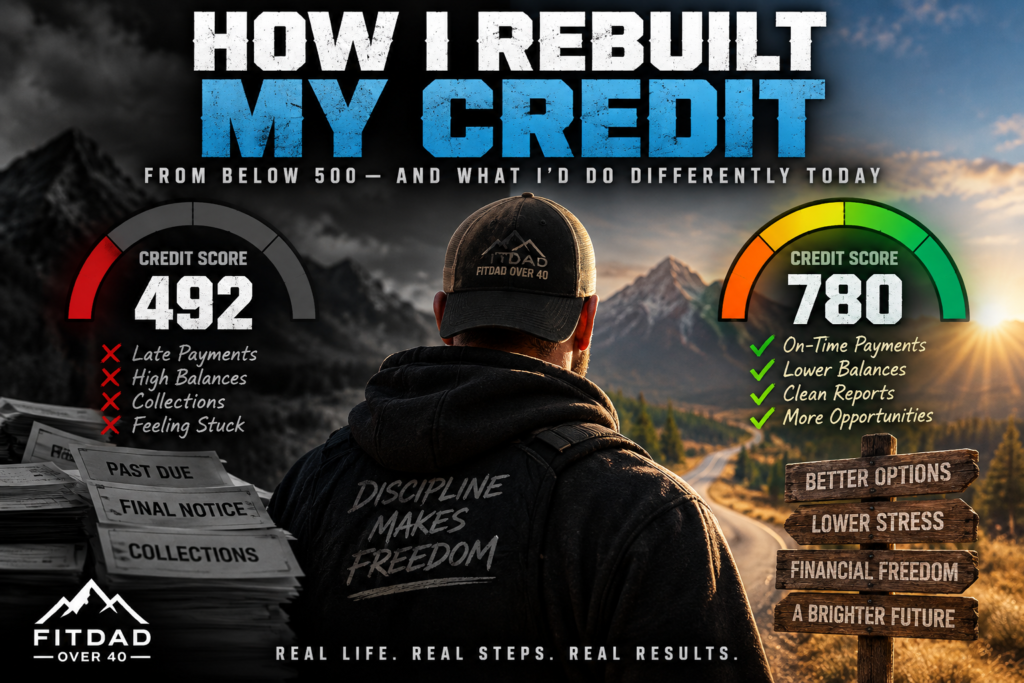
I didn’t fix my credit with a hack. It took education, discipline, some mistakes, and a whole lot of time.
When I was in my early 20s, I was in the military, and credit just didn’t seem that important.
Housing was taken care of. Insurance was taken care of. A lot of the expenses and financial decisions that hit you later in civilian life weren’t really on my radar.
My wife at the time was supposed to be handling our money.
She wasn’t.
And I wasn’t paying enough attention to know how bad things had gotten.
Eventually, I needed to move off base and get an apartment.
I thought I was fine.
I wasn’t.
My credit was garbage—below 500 at its worst.
There were bounced checks. Collections. Department-store credit cards that had been charged up and eventually charged off. I ended up needing an emergency loan just to get through the situation.
That was when credit stopped being some abstract number.
Bad credit suddenly affected where I could live and what options I had.
One of the biggest lessons I learned from that period has stuck with me ever since:
You can let somebody else pay the bills. You can’t hand over responsibility for your financial life.
Today, I pay attention.
My First Mistake Was Trying to Fix Things Before I Understood Them
Under it paste:
Once I realized how bad the situation was, I wanted to clean it up.
So I started contacting old creditors.
That seemed like the responsible thing to do.
The problem was that I didn’t understand the rules surrounding old debt.
Depending on the state and circumstances, acknowledging an old debt or making a payment can affect the statute of limitations for legal collection. That is different from the rules governing how long negative information can generally stay on a credit report.
I didn’t understand those distinctions then.
I was trying to fix my credit before I’d learned how credit actually worked.
If I were starting over today, I’d reverse that order.
I’d educate myself first. Then I’d act.
I Started Learning How Credit Actually Works
That mistake sent me down a rabbit hole.
I started learning everything I could about credit.
I learned about credit-reporting timeframes and how long different information can stay on a report. I learned how hard inquiries can affect a score. I learned the difference between revolving debt, installment loans and mortgages.
I learned about credit utilization and why carrying higher balances on revolving accounts could move my score even when I hadn’t missed a payment.
Most importantly, I stopped treating my credit score like something that just happened to me.
I started managing it.
Looking back, that change in mindset was probably as important as anything else I did. I couldn’t change the mistakes already on my reports overnight, but I could stop creating new ones.
I Started Rebuilding With a $100 Secured Card
I didn’t have thousands of dollars to throw at the problem.
I started small. Really small.
One of the tools I used was a secured credit card with a deposit as low as around $100.
The point wasn’t to have spending money. I was trying to start building positive credit history again.
A secured card requires you to put down money as security, but otherwise it can function much like a regular credit card. Used responsibly, it can be one way to begin establishing or rebuilding credit.
The credit limit wasn’t what mattered to me. What mattered was finally having an account I could manage correctly.
And that led to the most important part of my entire rebuild:
I started paying everything on time.
I Paid Everything on Time
No tricks here.
I stopped missing payments.
Month after month, I paid things when they were due.
I didn’t understand all the math behind credit scoring when I started. I just learned quickly that another late payment was the last thing my credit needed.
Today we know more about how FICO describes its scoring system. Payment history is the largest category in a typical FICO Score, accounting for about 35% of the calculation.
That doesn’t mean paying on time will magically give you good credit. Your score depends on several factors. But if I had to rebuild from below 500 again, protecting my payment history would be priority number one.
Today, I’d use automatic payments and reminders wherever possible. I learned this lesson the hard way. There’s no reason to rely on memory when technology can help make sure a payment doesn’t get missed.
I Watched My Credit Like a Hawk
Once I started rebuilding, I became almost obsessive about watching my credit.
I pulled my credit reports and went through them carefully.
When I found information I believed was legitimately wrong, I challenged it. I also contacted creditors when appropriate and sometimes succeeded in getting negative items addressed or removed.
There’s an important distinction here: accurate negative information generally can’t simply be disputed away because you don’t like it.
If I were rebuilding today, I’d review all three of my credit reports, dispute actual errors, and keep records of what I submitted and when.
I’d also keep monitoring my credit instead of waiting until I needed a loan or apartment to discover there was a problem.
What I Use to Monitor My Credit Today
I still watch my credit pretty closely today, and one of the tools I personally use is Credit Karma.
What I like isn’t just being able to see a score. Credit Karma has a credit simulator that lets me model different scenarios—things like paying down credit-card debt or missing a payment—and see an estimate of how those changes might affect my credit.
It’s important to understand that the simulator is an estimate, not a guarantee of what your actual score will do. But I’ve found it useful for understanding how different financial decisions might affect my credit before I make them.
Credit Karma also shows credit-card offers and estimated approval odds based on your credit profile.
I don’t treat those offers as recommendations to open a card.
Credit Karma makes money when people use certain products offered through its platform, so I still research any card or financial product before applying.
But when you’re rebuilding credit and don’t know what you might qualify for, I’ve found the approval-odds information useful as another data point. I’d rather have some idea of my chances than blindly apply for a bunch of cards and rack up unnecessary hard inquiries.
I use Credit Karma as a tool, not as somebody making my financial decisions for me.
And that’s an important distinction.
Credit Utilization Still Moves My Score
Even with my credit in the high 700s today, my score isn’t frozen.
It still moves around.
One of the biggest short-term movers I’ve personally noticed is credit utilization—how much of my available revolving credit I’m using.
If my credit-card balances climb, I can see the effect. When those balances come back down, I can see that too.
FICO includes “amounts owed” as another major part of its scoring model, accounting for about 30% of a typical FICO Score. Credit utilization is an important part of that category.
That doesn’t mean everyone’s score will react exactly like mine or that there’s one magic utilization percentage that guarantees a certain score.
What it taught me was simple: having available credit and using all of it are two very different things.
These days I don’t panic over every small score movement. I watch the underlying balances and the longer-term trend.
It Took More Than a Year Just to Reach the 600s
This is probably the part nobody wants to hear.
It took time.
It took me more than a year just to get from below 500 into the 600s.
After that, it was a steady, slow slog upward.
Eventually, I reached the high 700s.
There wasn’t one magical afternoon when I “fixed” my credit.
There wasn’t a secret letter, a loophole, or a company that erased my history.
I learned how credit worked. I established positive accounts. I paid everything on time. I watched my reports. I dealt with legitimate problems when I found them.
And then I gave the process time.
That’s boring. It’s also what worked.
What I’d Do If My Credit Were Below 500 Today
First, I’d find out exactly what I was dealing with. I’d pull all three credit reports, go through them carefully, and make a list of every account, balance, collection, late payment, and anything I believed was inaccurate.
Second, I’d stop creating new damage. Before worrying about gaining 50 points, I’d make absolutely certain my current bills were being paid on time.
Third, I’d dispute legitimate errors. Not accurate negative information I wished would disappear—actual mistakes.
Fourth, I’d start rebuilding positive history. If I couldn’t qualify for a conventional credit card, I’d look at a reputable secured card that reports to the major credit bureaus. I wouldn’t care whether the limit was $100 or $1,000. I’d care about managing it correctly.
Fifth, I’d watch my revolving balances. I’d pay attention to credit utilization and work on bringing high balances down rather than applying for more credit just to create additional room.
Sixth, I’d be stingy with new applications. I wouldn’t shotgun applications at every card that advertised to me.
Seventh, I’d monitor everything. I’d want to know when balances changed, when accounts updated, and whether the things I was doing were actually moving me in the right direction.
And if I were dealing with old collections or debts near legal or reporting deadlines, I’d understand the applicable rules before contacting anybody or sending money.
Then I’d do the hardest part:
I’d give it time.
The Biggest Thing Bad Credit Taught Me
Getting from below 500 to the high 700s taught me plenty about credit.
But the bigger lesson wasn’t really about credit scores.
It was about options.
When my credit was terrible, my choices got smaller.
An apartment became harder to get. Borrowing became more expensive or unavailable. An emergency became harder to handle.
As my financial situation improved, I got choices back.
That’s why I still pay attention to my credit today.
I’m 50 now. I’m interested in making more money, building businesses, getting healthier, and creating more options for the years ahead.
Credit isn’t the whole financial picture.
But I’ve lived on both sides of it.
I’d rather have options.
Note: This article is based on my personal experience and is for general educational purposes only. Credit situations vary, and laws regarding debt collection can vary by state. This isn’t individualized financial or legal advice.
Sources & Further Reading
- Federal Trade Commission — Debt Collection FAQs
- Consumer Financial Protection Bureau — How to Rebuild Your Credit
- Consumer Financial Protection Bureau — Credit Reports and Scores
- myFICO — What’s in Your Credit Score?

